Skip to content

Technology

Signal Login and the payment trail it leaves

A wallet on a wooden table with cash and cards sticking out, next to a smartphone and a set of keys
A wallet, a phone and keys, standing in for a registration that swaps the phone number for a payment and a key. Photo by Towfiqu barbhuiya on Pexels (Pexels License).

In Taiwan, Hong Kong and Macau, every mobile number, prepaid SIMs included, is registered to a real identity, and the same holds across most of East and Southeast Asia. A Signal account is opened against a phone number, so however strong the encryption, the carrier's registration record ties the account to a named person. For journalists' sources, activists working across borders, and anyone who does not want their account traced back to them, the phone number has long been the most cited limitation of Signal.

In September 2026 Signal's Android beta opened a way to register without a phone number, called Signal Login, in exchange for a small one-time payment. The obvious worry followed: doesn't the payment record bring your identity right back? Signal reuses the zero-knowledge credentials from its donation system so that an account cannot be matched to a specific purchase. The payment date still travels with the account, however, and Google keeps a record that you bought it. Whether to use Signal Login, and how to pay, depends on which kind of tracing you need to defend against.
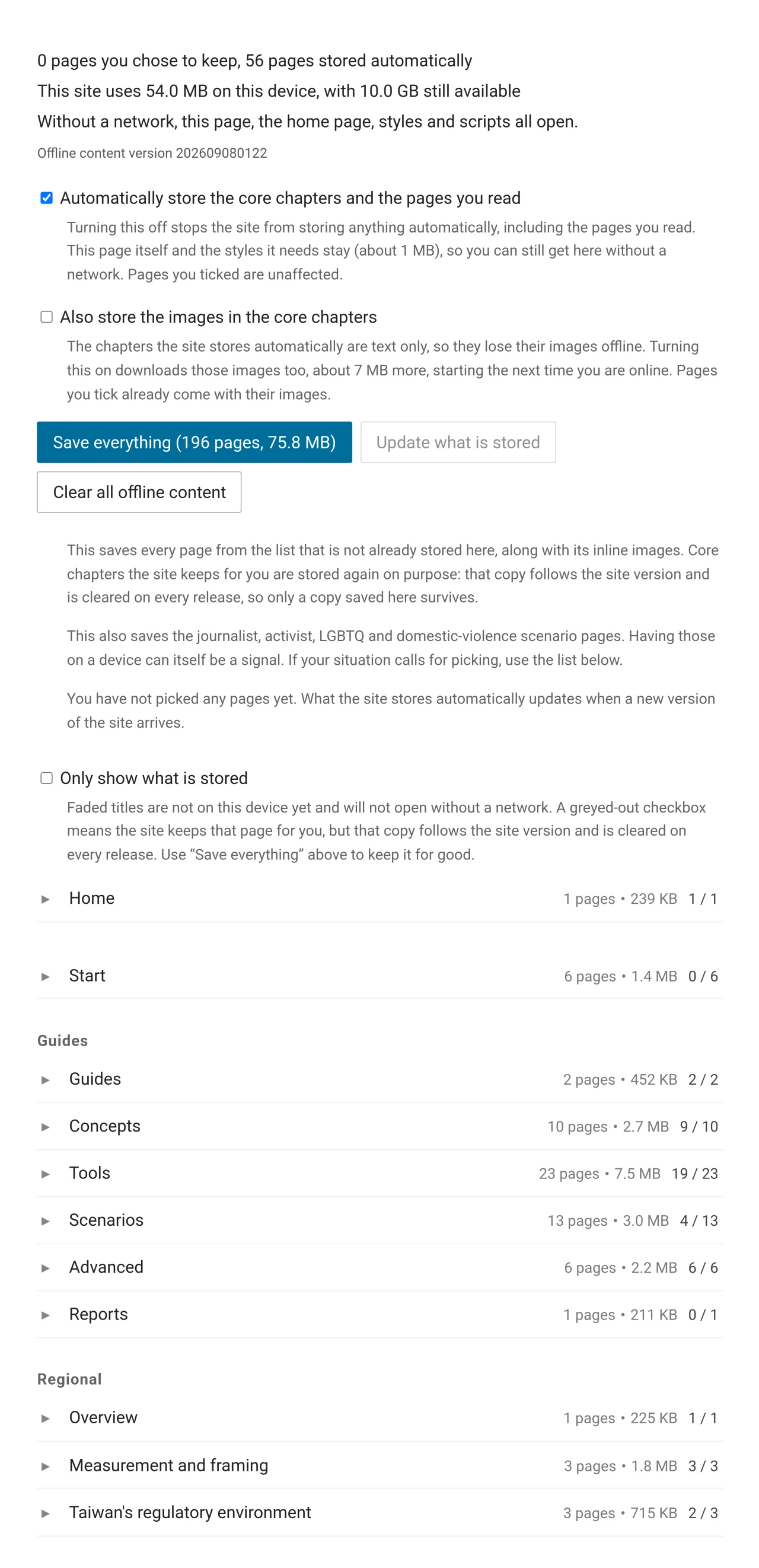
The docs site and its tools, available offline

When the network drops, the page you most need is often the one that will not open. On a flight, in the mountains, or in a new country before you have found a SIM, that is an inconvenience. Where the network is cut, throttled or blocked, the same situation costs far more.

From 4 to 6 September we were at Global Gathering 2026 in Estoril, Portugal. Alongside our booth on the last day we joined the Circles, where we talked about how the privacy material on the docs site is written and layered. The conversation kept returning to one premise: the moment a reader needs these pages is not reliably a moment with a working connection.

The top of the offline reading page: storage totals, the automatic-storage and inline-image switches, and the Save everything, Update what is stored and Clear all offline content buttons

Eight new tools on the docs site, all running in the reader's own browser

We are a group of volunteers working on anonymity networks and internet freedom, based in Taiwan. We maintain this documentation site, a practical guide to privacy and anonymity sorted by scenario for everyday life, sensitive work and high risk.

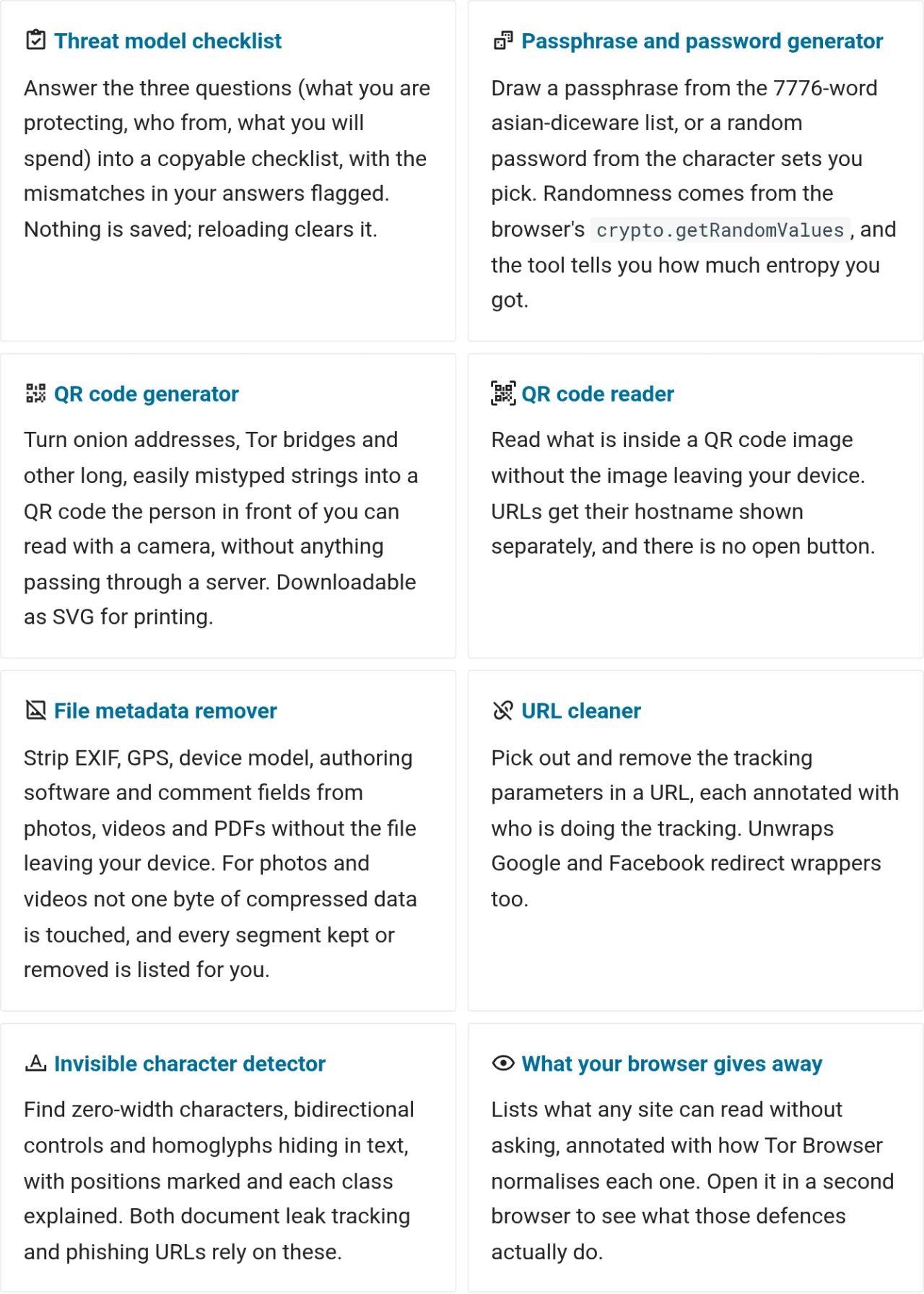
The articles on this site explain how to protect yourself. The tools section holds the things you can actually press. All eight compute in the reader's browser, send nothing anywhere, and keep working with the network off once stored on a device.

The tools index, eight cards each naming a tool and what it is for

What is Differential Privacy?

This article is based on the original explainer by fria at Privacy Guides:

Can you collect data from a large group of people while still protecting each individual's privacy? Differential privacy answers yes — with a mathematical proof to back it up. This article introduces the concept, traces its history from early anonymization failures to real-world deployments, and explores what it means for users and policymakers in Taiwan and the broader Chinese-speaking world.