Skip to content

News

The Anonymity Networks Community Is Going to Global Gathering 2026

Global Gathering 2026, hosted by Team CommUNITY, runs from 4 to 6 September in Estoril, Portugal. We applied for a booth and the slot is now confirmed.

  • Date and time: 6 September, 13:00 to 15:00 WEST (UTC+1, Portugal local time during the event)
  • Location: Booth 6 in the Regional Perspectives Village, 3 x 3 meters
  • Booth title: anoni.net Hub: Sinophone Asia-Pacific Networked Freedom

Event details are at Global Gathering 2026.

What the Global Gathering is

The Global Gathering is an annual event hosted by Team CommUNITY. It draws people from around the world whose work covers digital rights, internet freedom, and protecting civil society from digital attacks.

There is no main stage and no keynote, and the three days are built out of Circles, Meetups that bring together a region or a shared topic, and Booths open to anyone walking past. Villages then group those activities by theme, such as Circumvention Tech, Digital Security, and Regional Perspectives. Our booth sits in the Regional Perspectives Village.

Why we are taking part

This is our first time at the Global Gathering, and the main hope is to meet more people, both technologists developing anonymity networks and other circumvention tools, and others working across the Asia region.

We are a group of volunteers who care about anonymity networks and internet freedom, starting from Taiwan, and what we do covers keeping journalists' sources protected, letting activists organize without leaving traces, and helping people support sensitive causes without exposing who they are. All three rest on having an anonymity network that works. We run the Matrix home server im.anoni.net and this docs site, which keeps our observations and discussions somewhere they can be checked.

The community counts from the anonymity network workshop we ran in August 2025, where the first group of members came together. Three threads are open in 2026, with practical privacy guides sorted by scenario for everyday life, sensitive work, and high risk, campus Tor relays pushed forward together with EFF and the Tor Project and one already running at National Taiwan Normal University, and the anonymous payment work we are bringing to the booth.

Others across the Asia-Pacific work on the same problems, and so far each side has not known the other exists. Sinophone communities are spread across Taiwan, Hong Kong, China, Japan, and Southeast Asia, the situations they run into are connected, and opportunities to compare experiences are rare.

The other purpose is taking part in coordination across the region, since internet freedom work is rarely something a single community can finish, what any one of us can observe and maintain has limits, and most of these problems need more than one region to cover them properly. Establishing contact first is what makes working together possible later.

For the 30 minutes of mobile throttling in northern Taiwan on 13 August, we turned OONI's public data into a guided tour of what it recorded. Taiwan logged 238 connection speed tests from 47 devices that day, one of which saw its median download fall from 132,096 kbit/s to 1,223 kbit/s, and every query in the write-up runs without a key so anyone can recheck it. That record comes along to Estoril, and if anyone there is working on shutdowns or throttling, it is available for comparison.

We are bringing anonymous payment to the booth

The agenda went up in late August, and across the three days it covers shutdown response, circumvention tools, platform accountability, AI governance, and journalist safety. Having gone through the Circles, Villages, and Booths one by one, we found no session that takes financial privacy as its subject. Donor anonymity, cross-border disbursement, and what sanctions and currency controls do to civil society appear in no session title or description. A few sessions do take fundraising strategy and grant applications as their subject, where the focus is getting money in. How a payment reaches its recipient without exposing them goes unaddressed.

Sanctions lists, banks refusing to do business, donation records being subpoenaed: these are day-to-day realities for many organizations, with no matching discussion anywhere on the agenda.

We are making anonymous payment the main topic at our booth. As a community we are still at the research stage, gathering real situations, including who needs an anonymous money trail and under what circumstances, where current practice breaks down, and what limits regulation and compliance impose.

The people we would especially like to talk to:

  • Operators with cross-border disbursement experience: particularly where the recipient sits in a high-risk or sanctioned region.
  • Organisations that have dealt with donor anonymity: who know where the current tools fall short.
  • Projects blocked by financial controls: unable to receive support because a bank refused them or currency rules got in the way.
  • Anyone following the topic in research or advocacy: the regulatory side included.

Please just walk up during the booth slot, with no appointment and no prepared topic needed, and topics other than anonymous payment are just as welcome. The booth is meant to work as a regional meeting point, so that people in the room can find each other.

Another team from Taiwan is at the Gathering

Cofacts is here too, at Booth 10 on 6 September, 13:00 to 15:00 WEST, the same two hours as our own slot. They are showing Cofacts.ai, a multi-agent AI framework built on top of the crowdsourced fact-checking community and chatbot they have run for years.

The two subjects meet in the same place. A public sphere needs information that can be checked, and it needs a network that carries that information without exposing the people passing it along. Both booths are open the same afternoon, so please come to both.

Sessions on the agenda that overlap with our work

On anonymity and circumvention:

  • Technologist Meetup (4 September, 13:30 to 14:30) is where technologists working in digital rights and public interest technology get to know each other, hosted in the Circumvention Tech Village, and we are looking for people with experience maintaining measurement tools or self-hosted services.
  • Cross-Borders Storytelling: Device Searches, Metadata, and Collective Preparation compares experiences of device searches and metadata scrutiny across regions, and covers digital, legal, physical, and psychosocial preparation. Sinophone journalists cross jurisdictions often, and how others prepare is something we can put to use.
  • Can Signal Become Phishing-Resistant? addresses phishing aimed at journalists and activists, where the attacks abuse Signal's legitimate account recovery and device-linking workflows, with no software vulnerability required. How to write the risk in account recovery into a privacy guide is what we are after in this session.
  • Lights in the Tunnel: Co-Creating an Accountability Framework for VPN Transparency starts drafting a methodology for assessing VPN transparency and accountability, along with the providers to be evaluated. People keep asking us which VPN they can trust, so we want to know how that methodology turns into advice a user can act on.
  • Age Verification and Digital Identity Systems runs across two sessions, mapping how these systems are being rolled out and by whom, and discussing the harm-reduction pathways civil society can push for.

On measurement and regional coordination:

  • Strengthening Rapid Response Efforts to Censorship Events covers how groups around the world coordinate when censorship events emerge, including OONI's tools and methods for rapid response. We work with OONI's public data, and the August throttling write-up came out of the same methods.
  • Asia Meetup (4 September, 12:00 to 13:00) is a connection point for people working across the Asia region, and it is where we hope to meet others nearby working on adjacent problems.
  • Internet Shutdown Contingency Planning Help Desk builds a shutdown contingency plan around your own threat model, using the BRACE framework. Taiwan runs drills every year that give us something to compare against, and which parts of the framework connect is what we need to work out.
  • We See, We Archive, We Remember addresses how public-interest information can be preserved when it is being erased, drawing on archival work from Hong Kong, China, Iran, and Palestine.

Booths we plan to visit

  • The Onion Odyssey Cryptographic Universe is run by the Tor Project together with the Guardian Project (Orbot, Onion Browser), at Booth 22 in the Circumvention Tech Village, open all three days, and we want to hear about the friction Sinophone users hit with Orbot and Onion Browser.
  • Lockdown Systems brings OnionShare, which shares files, hosts websites, and runs chat anonymously over the Tor network, alongside Cyd for backing up and deleting social media history, and where a source gets stuck the first time they use it is exactly the kind of detail our privacy guides need.
  • Air Messenger is built on the MLS protocol, combining end-to-end encryption, low metadata, and a federated architecture, and since we run a Matrix home server ourselves, we want to know how far a federated setup can push metadata down.
  • Amnezia VPN shows their research on VPN blocking and DPI filtering, along with Amnezia Pulse for tracking shutdowns, and we want to compare our August throttling data against how they decide a shutdown is happening.
  • LEAP's MANTA measures tunnel health in censored environments, and we want to find out whether the same measurement approach fits the connectivity we see in Taiwan. Their booth (Booth 21) is open on 4 September only, 15:30 to 17:30, and a MANTA session runs in the Circumvention Tech Village earlier that day, 15:00 to 16:00.
  • po1ytech's polymorphic is an automated mirror system that keeps blocked independent media reachable, and we want to ask how much staffing it takes to keep running, because a volunteer community has limited capacity and sustainability comes first when choosing tools.

The full agenda is at Global Gathering 2026, and it runs far wider than what is listed here.

For those attending

Our booth is on the final day, which leaves no fixed spot for the first two days. Any of the following will reach us.

  • The Matrix room set up for the event is the most reliable, at #gg2026:im.anoni.net, where a message is enough to arrange a time and place, no phone numbers need to change hands, and we will reply as soon as we can during the event. Any Matrix account can join, so a free matrix.org account works and takes a couple of minutes to set up. Times in that room are in WEST unless someone says otherwise. Accounts on im.anoni.net are issued by a person and take a day or two, which is too slow for meeting someone at the venue, so do not wait on one.
  • Two sessions on 4 September are ones we will be attending, the Asia Meetup (12:00 to 13:00 WEST) and the Technologist Meetup (13:30 to 14:30 WEST), so meeting there works directly.
  • We will most likely be around for the Networking Hour, 12:00 to 13:00 WEST each day, though plans may still shift, so checking that room before you leave for Estoril helps. On 4 September that hour is where the Asia Meetup above sits, so it is one slot rather than two.
  • We will be at the venue for most of the three days, with anoni.net and a handle on our badges, so please do say hello.
  • The booth slot on 6 September, 13:00 to 15:00 WEST, is the easiest place to find us, and giving the name you go by is enough.

Taking part without travelling

Most people will not be travelling to Portugal, and there are still two things we can do together.

Please write down a coordination gap you have run into and send it to us, and we will take it along to compare against what other regions are seeing. Observations from Taiwan do not surface often at international events, and describing one concrete situation carries further than an abstract overview.

We would also like to hear real experiences of anonymous payment, so if you or an organization you know has dealt with small cross-border support, the trade-off between donation receipts and identity disclosure, or a recipient put at risk because a money trail identified them, that experience is what the booth needs. Anything you would rather not attach your name to can go to the anonymous mailbox below. We check it within a few hours across the three days of the Gathering, and reply within a day or two the rest of the time.

Beyond the event, all three threads for 2026 are short of hands. The privacy guides need people to sort scenarios and proofread, campus Tor relays need someone willing to ask about feasibility at their own institution, and the anonymous payment work needs more real cases. If you have compared the August throttling write-up against the raw OONI data and have something to add or correct, that is welcome too. Say which part interests you in the Matrix room.

Help pass this along

The booth runs for one slot only, and whether the right people walk past depends a great deal on how far word travels. If you know someone heading to Estoril, or there are journalists and open source community members around you working on these topics, please forward this to them, and there is no need to tell us first. If someone responds after you do, sharing that in the Matrix room helps us connect with them before we set off.

After the event

Whatever the booth collects will be written up and published in a later newsletter and on this docs site. We look at the situation a case arose in, and the people and the region involved stay out of anything published. Both the list of coordination gaps and the anonymous payment cases are de-identified first.

Channels

Retracting what we published, and what changed on the docs site in the past two weeks

What changed on the docs site

Several pages changed over the past two weeks, and in most cases the change was to withdraw a passage rather than extend it. Hong Kong moved from medium to high risk for device inspection, the exemption for eSIMs bought outside Japan came out, a 2FA app we recommended turned out to have changed owners, and a blocking distribution drawn from 40 samples was recomputed over all 22,105. The site merged 50 pull requests between 27 July and 10 August, and a sizeable share of them went into corrections of this kind. What follows is page by page: what changed, what the evidence was, and a checklist in the middle for anyone who already prepared using the old guidance.

COSCUP 2026 Anonymity Networks Community track needs on-site crew for three roles, Aug 8–9

COSCUP 2026 Anonymity Networks Community track hero image

The schedule is set and all sixteen speakers have confirmed. Across Aug 8 and 9 in room TR-510 at National Taiwan University of Science and Technology, the track runs from how censorship works and browser-fingerprint tracking, through the NTNU campus Tor node and data-privacy rights in the national health-insurance database, to the anonymous-payments session co-organized with ETHTaipei on the Aug 8 afternoon. Right now exactly one person is covering on-site operations.

Changeovers on Aug 9 are only five minutes long. Someone needs to raise the time card before a speaker runs over, and someone needs to use those five minutes to get the next speaker on stage with projection and audio tested. Several speakers have asked not to be recorded, so someone has to watch the whole way through and confirm nothing was captured. That one is unrecoverable if it goes wrong. On the Aug 8 morning there are invited civil-society groups and independent journalists arriving, so someone needs to greet people at the door and help them find seats.

We are looking for three on-site crew

  • Roles: recording (1), front-of-room runner (1), door runner (1)
  • Requirements: no background in Tor, anonymity networks, or any privacy technology
  • Availability: both days is ideal, one day is welcome too, and we will rotate shifts if enough people sign up
  • To sign up or ask: reach us through any channel on contact and tell us which role you want and which days you can make

How Unredacted Helps People in Censored Regions Reach the Open Internet

This post is based on a guest post on the Tor Blog by Unredacted, with an anoni.net community perspective added for Taiwan and the wider Sinophone region.

Keeping the doors open

Unredacted is a US-based 501(c)(3) non-profit that runs a network of 300+ servers to keep people in heavily censored places connected to the open internet. Their guest post is part of the Tor Blog's spotlight series on organizations defending the free internet, and it opens with a line from a user in China: "You have helped many many people to overcome the great firewall." That kind of message is rare, because people living under censorship usually have no safe channel to send one.

This post highlights what Unredacted builds, and what it looks like from where the anoni.net community sits, in Taiwan.

After Iran's 80-day blackout, traffic surged through our community's Tor WebTunnel bridge

For people in Iran, the outside internet barely existed for nearly three months. When connectivity started to come back a few days ago, the Tor WebTunnel bridge our community runs began taking on a wave of traffic. That was Iranians who had found a way around the censorship and reconnected to Tor, getting back onto the wider internet.

Wherever you are, you can help

If you have a VPS (a small cloud server) or a physical machine, plus a domain name, you can run a Tor WebTunnel bridge and give people cut off by censorship a way back onto the open internet. Can't run a server? Open a browser tab and run Snowflake instead, it contributes anonymous traffic just the same.

Server specs, legal considerations, and the full setup steps are written up in How to set up a Tor WebTunnel bridge.

CryptPad 2026.5.0: zh_Hant Lands as a Built-in Locale After Two and a Half Years Upstream

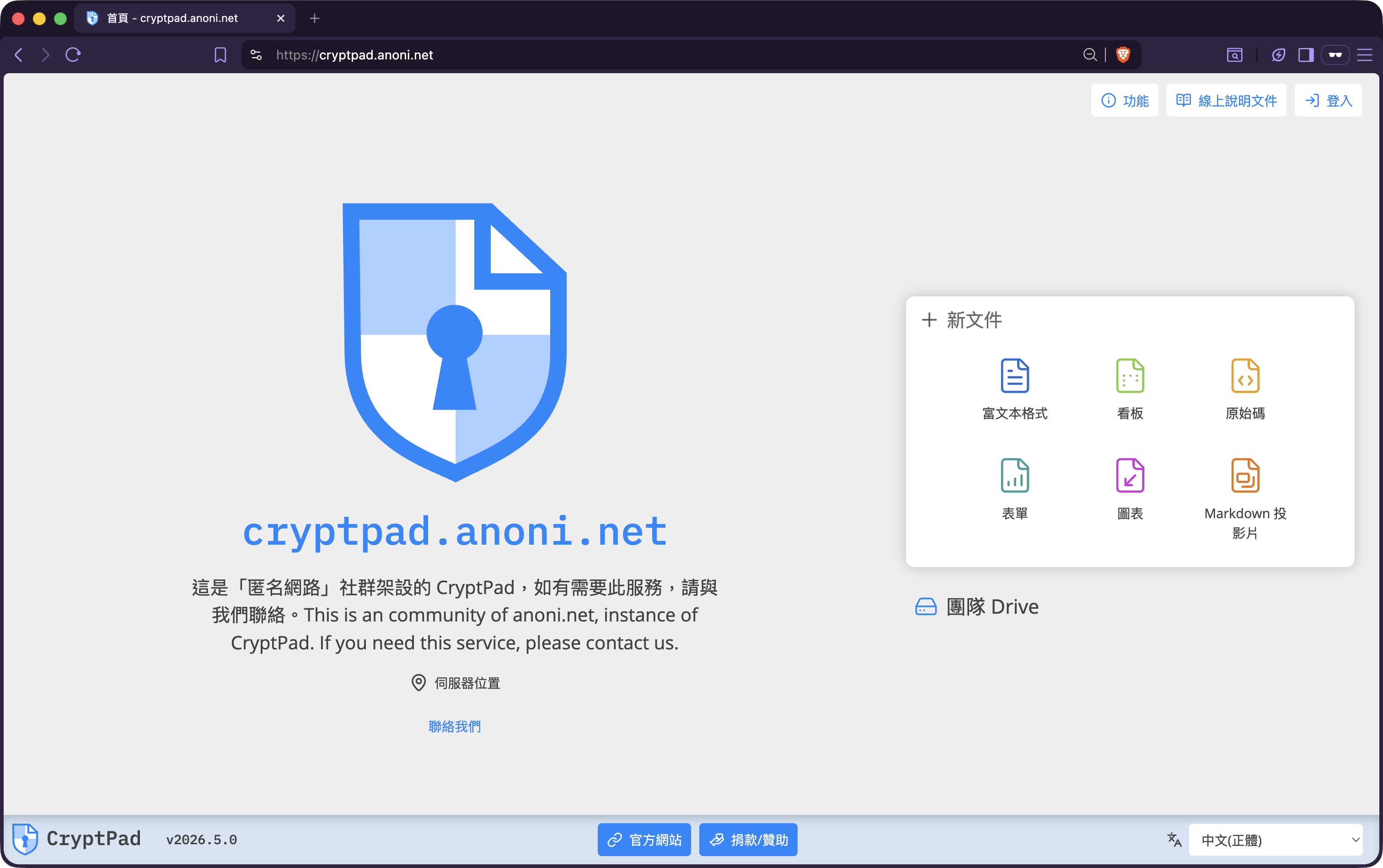
CryptPad Drive home in Traditional Chinese (zh_Hant). Left sidebar shows file categories; the +New button reveals Rich Text, Document, Sheet, Slides, Kanban, Whiteboard, Diagram, Forms, Calendar.
cryptpad.anoni.net Drive home after switching to 中文(正體). Every file category and app entry is localised.

For people who want a collaboration tool that does not silently keep a readable copy of their work on the server, the practical options are short. Google Docs, Notion, Microsoft 365 are excellent products, but every paragraph and every revision sits on those vendors’ servers in a form they can read. From there, algorithms, ads, training corpora, and government data requests each have their own path in.

That difference is exactly what matters when a journalist drafts a story that cannot leak, when a campaigner negotiates a strategy that cannot be wiretapped, when an NGO records distress reports from vulnerable users, or when a researcher works on a politically sensitive topic. Whether a first draft can be safely written at all often turns on that one architectural choice.

CryptPad is one of the few collaboration suites where the server genuinely cannot read what you wrote. Content is encrypted in your browser, the server only ever sees ciphertext, and yet a single interface covers most of what people normally reach for in Google Docs, Sheets, Slides, kanban boards, whiteboards, forms, and calendars.

Until recently the suite had one obvious gap for one large group of users: the UI shipped in English and Simplified Chinese only, with Traditional Chinese (zh_Hant) missing. From the first upstream PR opened at the end of 2023, through two and a half years of patient string-by-string work in Weblate, to the CryptPad 2026.5.0 “🌷 Spring release” on 2026/05/13, zh_Hant is now a built-in locale. The community-hosted cryptpad.anoni.net has been upgraded. Open cryptpad.anoni.net today and the Drive, the document editors, and the share-permission dialog are all in Traditional Chinese. Readers in Taiwan, Hong Kong, Macau, and across the Chinese-reading diaspora can use it without first learning an English menu.

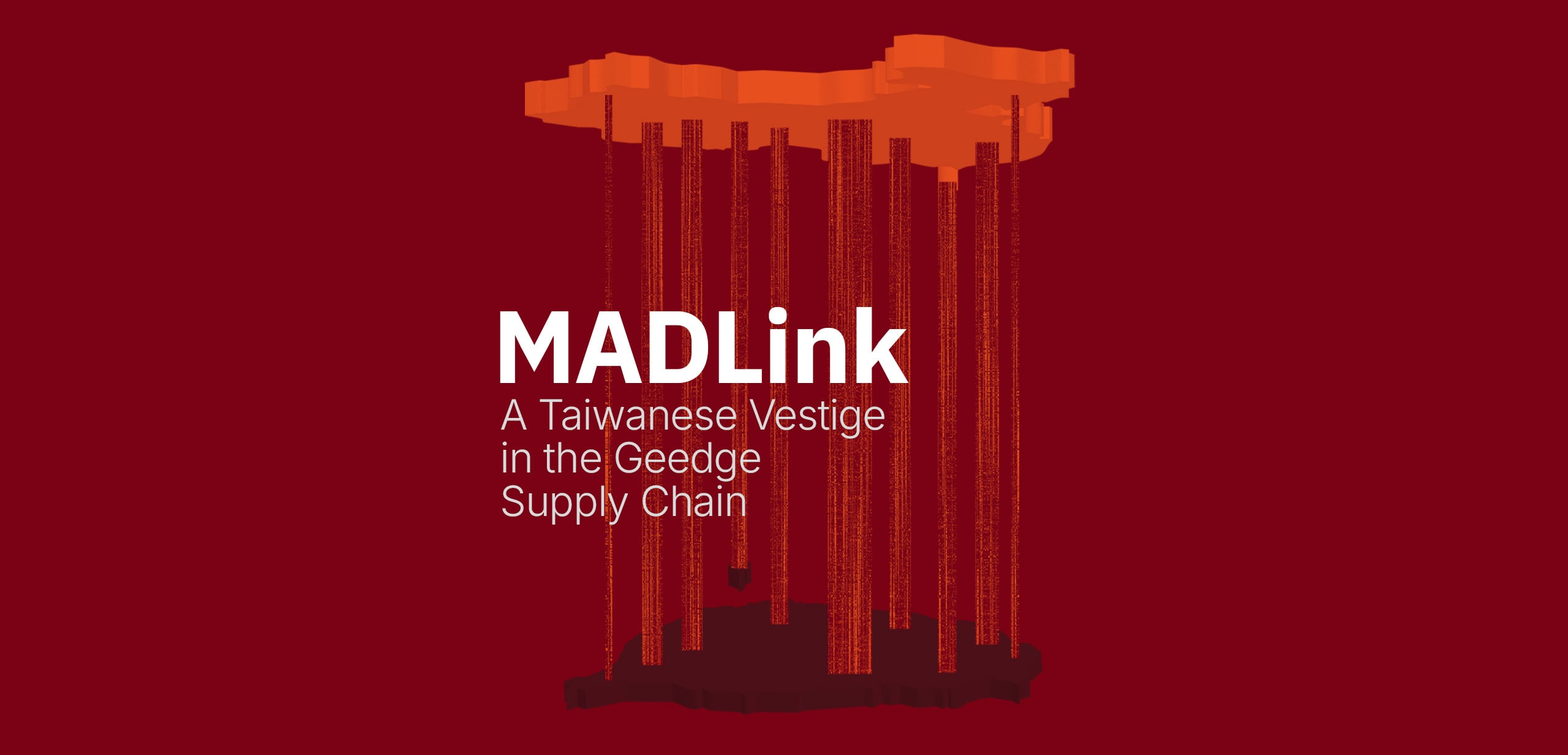
MADLink report cover

A publicly listed Taipei-traded company shipped 1,708 CSA-7400 high-density network platforms to a Chinese customer between 2019 and 2020. Those appliances ended up in Kazakhstan running a national-grade internet censorship and surveillance system. The supplier was ADLINK Technologies (TWSE: 6166), the customer was Geedge Networks, and the system they ran was the flagship Tiangou Secure Gateway (TSG), an offering whose capabilities rival China's Great Firewall.

That is the central finding of MADLink: A Taiwanese Vestige in the Geedge Supply Chain, InterSecLab's April 2026 report and the first follow-up to their September 2025 The Internet Coup. The anoni.net community has completed the Mandarin (Taiwan terminology, zh-TW) translation. Unlike the previous Internet Coup release, this round also ships an editorial observation page mapping how Taiwan's media, government, and legislators have received the report — with an English summary written for international readers.

Campus Tor Relay templates: proposal, SOP, and FAQ now published

Campus Tor Relay template kit

In November 2025, the first campus Tor Relay in Taiwan went live at National Taiwan Normal University's CSIE department. Over the past six months, community member NZ (Su En-Li) — the student who pushed the proposal through — worked with the community to turn that experience into a reusable template kit. The three documents are now published under CC-BY 4.0, with a long-form interview as the entry point.

The templates are ready. The next step is for more universities to take them up.

onionoo MCP is now public: query the Tor relay network in plain language

onionoo MCP launch

The community-hosted onionoo-fastapi service is now public at https://onionoo.anoni.net, released as v1.0.0. It wraps the Tor Project's official Onionoo API in two interfaces: a semantic HTTP API with a full OpenAPI document, and a Model Context Protocol (MCP) server.

Connect it to Claude Desktop, Cursor, Claude Code, or any MCP-capable client and you can ask a single question like "how many running Tor relays does Taiwan have right now, what is the total bandwidth, and what are the top five ASNs?" The agent breaks the question down, picks tools, fetches the data, and returns a readable summary. You do not need to learn Onionoo's field schema before starting research.

Taiwan’s Virtual Asset Service Bill: What the Cabinet Approved (and What Happens Next)

Policy update

On 2 April 2026, Taiwan’s Executive Yuan (the cabinet) approved the Financial Supervisory Commission’s draft Virtual Asset Service Act and sent it to the Legislative Yuan for review. If you follow crypto policy or stablecoins, this matters because Taiwan is moving from an anti–money laundering registration regime toward a licensing regime for service providers. This post is a status briefing that gathers the April 2026 cabinet move in one place for readers who mostly skip the Mandarin policy wires. It stays at the policy level. For legal questions, talk to a qualified professional in Taiwan.